

Paediatric dentistry: a complete guide for parents to children's dental health, first visits and keeping teeth healthy for life
Children's dental health is one of those areas where early decisions genuinely matter long-term. The habits formed in childhood — how children feel about the dentist, how they learn to brush, what they eat and drink, whether small problems are caught before they become large ones — shape their oral health for decades.Paediatric dentistry is the branch of dental care focused specifically on children, from the appearance of the first baby tooth through to early adulthood. Understanding what it involves, when to start, what to watch for and how to manage common childhood dental concerns gives parents the confidence to act at the right time rather than second-guessing when something needs attention.At Winchester Avenue Dental Surgery in Leicester, led by Dr Zeinab, our principal dentist, we see patients of all ages — including young children coming in with a parent for their first experience of a dental practice. Our approach to children is patient, unhurried and focused on making the visit positive. We also offer emergency dental appointments seven days a week for just £40 for situations involving acute pain, trauma or infection — including for children who need urgent care outside of normal hours.This guide covers everything parents need to know.
When should a child first see a dentist?
The standard recommendation from the British Society of Paediatric Dentistry and the NHS is that children should attend their first dental appointment around the time their first tooth appears — typically between six and twelve months of age. At the very latest, the first visit should happen before the child's first birthday.This might feel very early, particularly when there is so little to examine. But the purpose of this first visit is not to find problems — it is to establish the relationship between the child, the parent and the dental environment as early as possible, and to allow the dentist to give parents specific guidance on diet, tooth cleaning and what to expect as more teeth appear.Children who begin attending the dentist very early tend to grow into young people who are comfortable at dental appointments. The practice becomes a familiar, non-threatening environment — not a place visited only when something is wrong or hurting.From the first visit, the recommendation is to attend every six months for a routine dental check-up for as long as the dentist considers this appropriate. In children with no particular risk factors, annual or six-monthly appointments are standard. Children with a higher risk of decay — due to diet, medical conditions, or previous dental problems — may benefit from more frequent visits.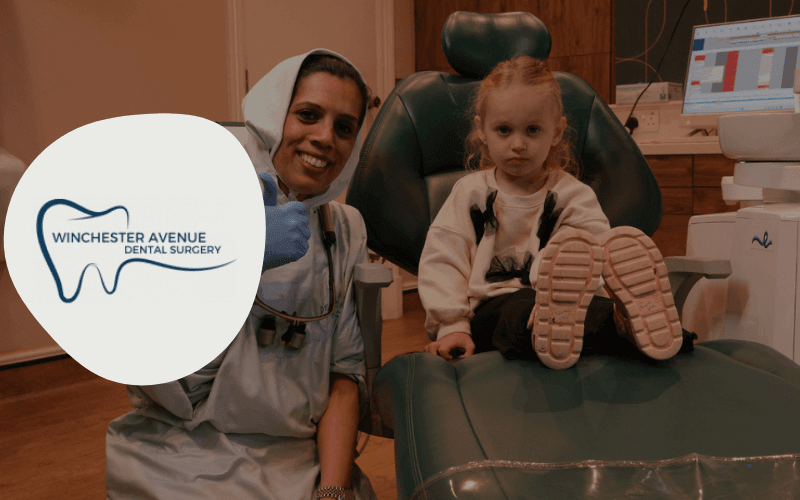
Why baby teeth matter more than most parents realise
One of the most common misconceptions in paediatric dentistry is that baby teeth (primary teeth) are not particularly important because they are going to fall out anyway. This underestimates their significance considerably.- Primary teeth hold space. The baby teeth act as placeholders for the permanent teeth developing beneath them in the jaw. When a baby tooth is lost prematurely — through decay, trauma or extraction — the adjacent teeth drift into the space. This reduces or eliminates the room that the permanent tooth beneath it needs to erupt correctly, contributing to crowding, misalignment and the need for orthodontic treatment later.
- Primary teeth enable eating and speaking. A child who loses multiple teeth to decay before the permanent teeth are ready to erupt faces real functional challenges — with chewing, with speech development, and sometimes with self-confidence.
- Decay in baby teeth signals risk for the permanent teeth. Children who develop significant decay in their primary teeth are at significantly higher risk of decay in their permanent teeth. The bacteria responsible for dental caries (Streptococcus mutans and related species) establish themselves in the mouth early and persist. A high caries rate in primary dentition is a signal that the permanent teeth need increased preventive attention, not a reason to be less concerned because these teeth are temporary.
- Untreated decay causes pain and infection. The most direct consequence of ignoring decay in baby teeth is that the child experiences pain and — in more serious cases — dental abscess, facial swelling, and the kind of acute infection that requires urgent treatment. This is the outcome paediatric dentistry is specifically designed to prevent.
What happens at a child's dental check-up
A paediatric dental check-up at Winchester Avenue Dental Surgery follows a sequence that is adapted to the child's age, temperament and previous experience.For very young children, the first appointments are typically brief and focused on familiarity — letting the child sit in the chair, explore the environment at their own pace, and experience the dentist looking at their teeth with a mirror. No instruments, no treatment, no pressure. The goal is a positive experience.As children become more comfortable and more teeth are present to examine, the check-up includes:- Visual examination of every tooth. Looking for early signs of decay, changes in enamel colour or texture, any visible damage or wear, and the development and eruption pattern of both primary and emerging permanent teeth.
- Gum assessment. Checking the gum tissue around the teeth for signs of inflammation, which is often the earliest indicator of inadequate cleaning in the areas children typically miss.
- Bite and development monitoring. Assessing how the primary and then the mixed dentition (the period when primary and permanent teeth coexist) is developing, and identifying any early concerns about alignment, spacing or jaw development that might benefit from early orthodontic assessment.
- Diet and hygiene discussion. A conversation with the parent — and with older children directly — about what they are eating and drinking, how they are brushing, and any habits (thumb sucking, dummy use, bottle feeding with sweet drinks) that are relevant to dental health.
- X-rays when indicated. Dental X-rays for children are taken when clinically necessary — typically to assess decay between the back teeth that cannot be seen visually, or to check the development of unerupted permanent teeth. The doses used in modern dental X-rays are very small.
The most common dental problems in children and how they are managed
Tooth decay (dental caries)
Dental decay is the most common chronic disease in children globally, and the UK is no exception. Despite fluoride in toothpaste and water, childhood tooth decay remains prevalent — driven largely by the frequency and volume of sugar in children's diets and, in younger children, by prolonged bottle or breastfeeding at night.The bacteria that cause decay produce acid when they metabolise sugar. This acid demineralises the enamel surface. Frequent sugar exposure — multiple sugary snacks and drinks throughout the day — means the enamel is under repeated acid attack without sufficient recovery time.The practical prevention messages are about frequency, not just amount: a child who has a biscuit at mealtimes is exposing their teeth to one sugar event. A child who grazes on crackers, juice and biscuits throughout the day is exposing their teeth to dozens. The frequency is the key driver of decay risk.Early-stage decay in children can sometimes be arrested and remineralised without fillings — with dietary change, improved brushing with fluoride toothpaste, and professional fluoride treatments applied at the dental practice. Established decay requires a filling. In cases where a primary tooth is heavily decayed and cannot be restored, extraction may be necessary — with consideration of whether a space maintainer is needed.Dental trauma
Children fall. They run into things, they collide with each other during sport, and they have accidents on bikes, scooters and playground equipment. Dental trauma in children is very common, and the appropriate management depends entirely on what type of injury has occurred and which teeth are involved.Chipped or fractured teeth: Where a tooth has fractured without exposing the nerve, the sharp edge can be smoothed and a composite resin restoration placed. Where the fracture exposes the pulp (nerve), more complex treatment is needed, which varies depending on whether the tooth involved is a primary or permanent tooth.Knocked-out teeth: A primary (baby) tooth that is knocked out completely should not be reimplanted — attempting to reimplant it risks damaging the developing permanent tooth beneath it. A permanent tooth that is knocked out is a dental emergency. The tooth should be handled by the crown (not the root), kept moist (in milk, saline, or inside the child's cheek if old enough), and the child brought to a dentist within 30 to 60 minutes. The window for successful reimplantation closes rapidly.Displaced teeth (luxation injuries): A tooth that has been pushed inward, pulled outward, or tilted by an impact needs clinical assessment as soon as possible. Management depends on the severity and which teeth are involved.For any dental injury in a child, seeking prompt professional assessment at a paediatric dentist or emergency dental service is always the right response. At Winchester Avenue Dental Surgery, we see children for dental trauma as emergency appointments seven days a week at just £40 for the consultation.Fissure sealants
The biting surfaces of the back teeth (molars and premolars) are covered in pits and fissures — the grooves that help grind food. These fissures are often too narrow to be cleaned by toothbrush bristles, making them prime sites for decay in children whose enamel is still maturing.Fissure sealants are a preventive treatment in which a thin plastic material is flowed into these fissures and set with a curing light, sealing the grooves against bacteria and food debris. They are painless, quick, and significantly reduce the risk of decay on the occlusal surfaces of the back teeth.Sealants are typically applied to the first permanent molars when they erupt, around the age of six to seven. The second permanent molars, erupting around twelve, are also commonly sealed. Sealants last for several years before they need to be replaced and are a cost-effective preventive investment.Dental anxiety in children
Children develop dental anxiety for many of the same reasons adults do — a previous uncomfortable experience, the unfamiliarity of the environment, sensitivity to parental anxiety, and the natural wariness that comes with anything involving a stranger putting things in your mouth.Paediatric dentistry places particular emphasis on preventing rather than managing dental anxiety — because a child who develops a negative association with dental care early is much more likely to become an avoidant adult.The techniques that work best in paediatric dentistry for anxious children include:Tell-show-do: Explaining and demonstrating everything before doing it. Showing the mirror before putting it in the mouth. Letting the child hold the air syringe before it is used. This converts unfamiliar into familiar.Positive reinforcement: Praising cooperation specifically and genuinely. Not belittling fears or comparing to how "brave" other children are.Working at the child's pace: An appointment that ends without clinical treatment because the child was not ready is not a failed appointment — it is a foundation for a successful one next time.Parental management: Children are extraordinarily perceptive to parental anxiety. A parent who is visibly nervous before the appointment, or who has communicated their own dental fears to the child, can inadvertently transfer that anxiety. Simple, matter-of-fact language ("we are going to the dentist to check your teeth") is more effective than elaborate positive spin that draws attention to the event.For older children and teenagers whose anxiety is significant, the same sedation options available to adults can be considered for necessary treatment.Diet, fluoride and prevention — the fundamentals
The most impactful preventive measures for children's dental health are accessible to every parent. None of them are expensive. All of them make a significant difference.- Fluoride toothpaste: Use it from the appearance of the first tooth. The recommended concentration for children up to age three is at least 1,000 ppm fluoride; children three and above should use the same 1,450 ppm fluoride toothpaste as adults. A smear for under-threes; a pea-sized amount for three and above. Spit and don't rinse — allowing the fluoride to remain in contact with the tooth surface longer.
- Brushing routine: Twice daily, supervised by a parent until the child has the manual dexterity to brush effectively on their own — usually around the age of seven or eight, but this varies. Check by brushing yourself after the child has brushed, particularly the back teeth and the tongue-side surfaces.
- Sugar frequency: Limit sugary foods and drinks to mealtimes. This is the single most impactful dietary change for reducing decay risk in children. Water and milk are the appropriate drinks between meals. Fruit juices — even unsweetened — are acidic and sugary, and should be limited to mealtimes.
- Fluoride supplements and treatments: In areas where the water is not fluoridated, or for children at higher decay risk, topical fluoride applied at the dental practice provides an additional protective layer for the enamel.
Emergency dental care for children in Leicester
Children have accidents outside of normal hours. Teeth get knocked out on Saturday afternoons. Infections develop over bank holiday weekends. Toothache does not observe school term times.At Winchester Avenue Dental Surgery in Leicester, we offer emergency dental appointments seven days a week, including weekends, for just £40 for the consultation. With over 850 five-star reviews from patients — including parents who brought children in for emergency care — our team understands how distressing a dental emergency involving a child can be, and we prioritise seeing them quickly, assessing the situation properly and providing immediate relief.If your child has knocked out a tooth, is in significant dental pain, has facial swelling or a suspected dental abscess, call us. Do not wait until Monday.You can view all our treatment fees for adults and children at our prices page.In conclusion
Paediatric dentistry is not a separate specialty that requires a specialist practice for most children. It is a set of principles — early introduction, preventive focus, positive experience building, appropriate management of common childhood dental problems — that any well-run dental practice applies when seeing children.Starting early, attending consistently, maintaining good dietary habits at home, and supervising brushing until children can reliably do it themselves: these are the foundations on which a lifetime of dental health is built.At Winchester Avenue Dental Surgery in Leicester, Dr Zeinab and the team welcome children at every stage — from first appointments for toddlers through to teenagers managing their own oral health. Routine check-up appointments are available for the whole family, and our emergency service at just £40 is here seven days a week when something cannot wait.Disclaimer
The information in this article is intended for general educational guidance only and does not constitute personalised dental or medical advice. For concerns about your child's dental health, please book an appointment with a qualified dental professional for a proper clinical assessment.Winchester Avenue Dental Surgery is a private dental practice in Leicester, led by Dr Zeinab. We offer routine dental check-ups for children and adults, emergency dental appointments seven days a week for just £40, dentures, Invisalign, composite bonding, porcelain veneers, teeth whitening and dental crowns. View all treatment fees at our prices page.Frequently asked questions
What age should a child first see a paediatric dentist?
Around the time the first tooth appears — typically between six and twelve months — and no later than the first birthday. This first appointment is less about clinical examination and more about establishing a positive relationship with the dental environment early. Children who begin attending routine dental check-ups from a young age almost always develop into more relaxed dental patients than those who first attend because of a problem or pain.
My child is afraid of the dentist. What should I do?
Avoid forcing the experience, avoid using the dentist as a threat ("if you don't brush your teeth you will have to go to the dentist"), and avoid communicating your own dental anxiety. Book an appointment at a practice that takes time with children and is willing to work at their pace. A first appointment that involves nothing more than sitting in the chair and meeting the team is entirely appropriate. Paediatric dentistry best practice is built around prevention of dental anxiety through positive, gradual exposure — not pushing through the discomfort. At Winchester Avenue Dental Surgery, we take all the time needed to make children feel safe.
My child knocked out a tooth. What should I do right now?
If it is a baby tooth, do not try to reimplant it — this risks damaging the permanent tooth beneath. Keep the child calm, apply gentle pressure to the socket if bleeding, and contact a paediatric dentist or emergency dental service for assessment. If it is a permanent tooth, handle it by the crown only, keep it moist (in milk, saline or inside the child's cheek), and get to a dentist within 30 to 60 minutes — the sooner the better. Call our emergency line immediately: we are available seven days a week at just £40 per consultation.
How do I know if my child has tooth decay?
Early decay in children is often invisible — a dentist needs to examine the teeth with a probe and sometimes X-rays to identify it in its early stages. More advanced decay may present as a white, brown or black discolouration on the tooth surface, a visible hole, sensitivity when eating sweet or cold foods, or — in more serious cases — pain, swelling or a visible abscess on the gum. If you notice any of these, book a dental check-up promptly rather than waiting for the next routine appointment. Decay progresses more quickly in children's teeth than in adults' because the enamel is thinner and less mineralised.
At what age should children brush their own teeth without supervision?
Most children do not have the manual dexterity to brush their teeth effectively without adult assistance until around age seven or eight — and even then, supervision and occasional checking is valuable until the early teens. Until that point, parents should either brush for the child or check and re-brush after the child has had their turn. The back teeth, the tongue-side surfaces of the lower front teeth, and the gum margins are consistently the areas children miss. A dental check-up appointment gives the dentist the opportunity to show children how to improve their technique using their own teeth as the demonstration — which tends to be more effective than abstract instruction.